
Podcast: Download (34.6MB)
Episode 135 VR Workforce Studio
Community Academies – Collaboration in Action
Rick Sizemore, rick.sizemore@dars.virginia.gov 540-688-7552 @vrworkforce
Rick Sizemore, VR Workforce Studio 540-688-7552
Betsy Civilette, DARS Communications Director
Find your local Vocational Rehabilitation office
Consumer Showcase Podcast YouTube https://youtu.be/NK0_qITXYo0
Work Makes the World Go Round – Music Video
VA DARS Business Development Unit
Erik K. Johnson Podcast Talent Coach
Council of State Administrators of Vocational Rehabilitation and the National Employment Team
National Clearinghouse of Rehabilitation Training Materials
Heather Servais hservais@neweditions.net @RSA_NCRTM
Virginia Department for Aging and Rehabilitative Services
Rehabilitation Services Administration
National Rehabilitation Association
Department of Labor Office of Disability Employment Policy
Wilson Workforce and Rehabilitation Center 540-332-7000 or 800-345-9972
George Dennehy with the Goo Goo Dolls George Dennehy
Lead On Lead On VR Music Video featuring George Dennehy and the Voices of Rehabilitation
Click Here for the Music Video
Lead On Lead On Karaoke – Free Download, now you can sing the VR National Anthem with a professional soundtrack from your phone. Click Here for the Free Karaoke Video
Voice Talent by Jake Hart. Jake is a volunteer for Vocational Rehabilitation’s Partners in Podcasting. jakehart@gmail.com www.jakehart.org

Webpage: DIF 101: Driving Workforce Growth Through Disability Employment (NCRTM) – This webpage is designed for audiences who are both new to and already familiar with the Disability Innovation Fund (DIF) Program. The page helps users better understand the program’s foundation and history, while highlighting DIF-funded projects that are driving better employment outcomes for Americans with disabilities. The interactive DIF map tool allows anyone to find a DIF-funded project by state. Users can easily access and view information, goals, and successes for each DIF project all in one convenient place.
Video: Disability Innovation Fund (DIF) 101: What You Need to Know About These Powerful Programs (NCRTM) – This video provides an up-to-date overview of the DIF Program, its history, and projects. Key achievements and successes are also highlighted in this video. 1 CRC credit is available.
Follow the New NCRTM LinkedIn Page!
NCRTM has officially launched a LinkedIn page. The NCRTM LinkedIn page will serve as an extension of the NCRTM website by sharing helpful resources and information for vocational rehabilitation professionals, educators, service providers, people with disabilities, and their families.
The National Clearinghouse of Rehabilitation Training Materials (NCRTM) is maintained by New Editions Consulting, Inc.and sponsored by the U.S. Department of Education, Rehabilitation Services Administration (RSA). The contents of this document were developed under contract 91990023D0037-91990024F0377 from the U.S. Department of Education (Department). The Department does not mandate or prescribe practices, models, or other activities described or discussed in this document. The contents of this document may contain examples of, adaptations of, and links to resources created and maintained by another public or private organization. The Department does not control or guarantee the accuracy, relevance, timeliness, or completeness of this outside information. The content of this document does not necessarily represent the policy of the Department. This document is not intended to represent the views or policy of or be an endorsement of any views expressed or materials provided by any Federal agency. (EDGAR 75.620)
Transcript
Betsy Civilette: Wow.
Tramarr Abdullah: More financial stability and income and supporting my family the way I want to.
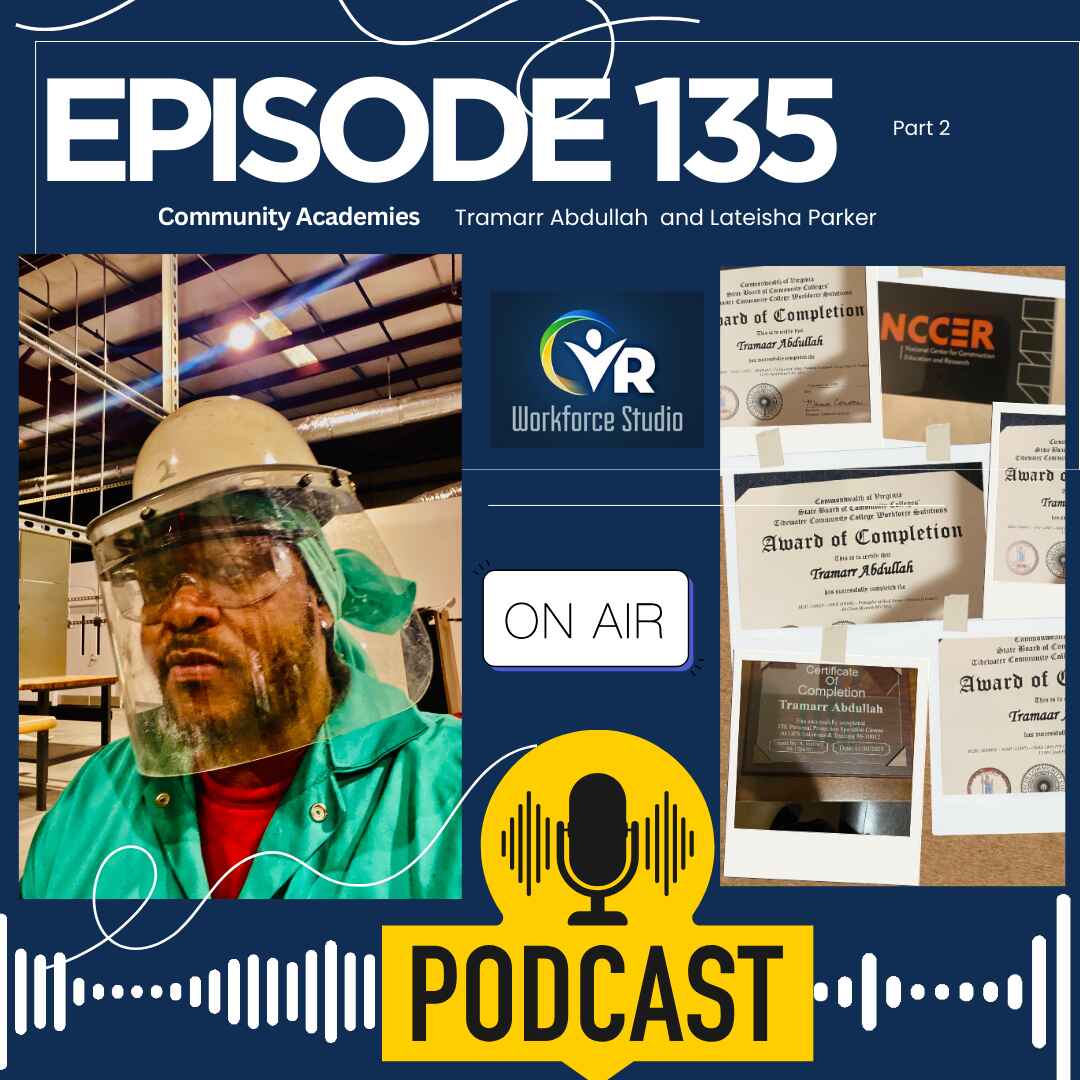
Rick Sizemore: I mean, we have some of those on the screen-
Tramarr Abdullah: Okay.
Rick Sizemore: You can see there, and not all of them, because that’s pretty amazing number of certifications that you were able to achieve. And as you went through these programs though, I’m really curious, you mentioned transportation because your car was broken-
Betsy Civilette: Yes.
Rick Sizemore: And some counseling, but were there any accommodations and what kind of things were you and Lateisha talking about that kept you on track and helped you stay motivated? Because these are not easy certifications to get-
Tramarr Abdullah: No.
Rick Sizemore: Electric and the DCJS and everything that you were able to do. How did your work with Lateisha-
Tramarr Abdullah: When I went to her office-
Rick Sizemore: Keep you on track?
Tramarr Abdullah: And we talked, I had to put my pride aside and everything. I mean, I had tears in my eyes at the time because I was like, I thought this was going to be the it for me. But when I looked at the financial entry level positions of electrician and different things of that nature, she was able to narrow some stuff down and I’m telling her, I’m like, “You mean to tell them I got to go back to school again or I got to continue to…” She was definitely giving me encouragement and I was like, “Wow.” So she definitely believed and poured into me, her and the whole DARS family for, the DRS family for real. So I’m…
Betsy Civilette: Yeah.
Rick Sizemore: Well, I’ve seen this woman in action and you talk about, you did mention sort of encouragement. I think it was a swift kick.
Tramarr Abdullah: Definitely.
Rick Sizemore: Tell us what that was like. I mean, she had to shock you out of where you were into something new.
Tramarr Abdullah: Oh, man.
Rick Sizemore: How did she do that?
Tramarr Abdullah: Encouraging, so inspirational. When I would come in her office, I would check in. I said, “I completed this. I completed that.” She’d say, “Well, take the next step, go further because you can get this, you can get that and just utilize the resources.” And just listening to her, taking heed to what she was saying, that empowered me for… The work that you guys do is tremendously well. I congratulate you all because I learned about the housing, Virginia Housing Authority and stuff like that. In position right now to get my credit.
Betsy Civilette: Okay.
Tramarr Abdullah: They’re paying $2,000 for my credit to be straight and all that, so I can move into actually a home, ownership of home, stuff like that. So I learned a lot in that meeting and Lateisha definitely opened up a lot of doors for me, opened up my eyes to how great I can be out here in this world pursuing career goals. And I thank you for that too. Definitely.
Betsy Civilette: Yeah. Well, Lateisha, let’s bring you into the conversation here. From the counselor’s perspective, what stood out to you about Tramarr’s motivation, his progress, and the determination that he brought to each of these training programs?
Lateisha Parker: Well, when Tramarr came to me as a consumer, one thing I noticed about Tramarr, he was very determined. I could tell that he had a passion for wanting to do better, and that’s where it all starts. You have to be open and willing to new opportunities and wanting to do better. One thing about Tramarr that stood out was his follow through. Every time that Tramarr looked for a new job, or filled out an application, or went to a new training, he always kept me updated. So I provided the resource to him with the Tidewater Community program. And I told him, I said, “Take advantage of this,” because he did express that he wanted to do electrician HVAC. So I said, “Well, just take advantage of it.” But I did let him know, I provided a lot of counseling guidance because when Tramarr came, he was very excited, but he was very anxious and he was very nervous at the same time.
So on a weekly basis, I was providing a lot of counseling and guidance because Tramarr will call me on a weekly basis with something new, which was exciting, but I tried to gear him and let him know, let the main thing be the main thing. And my main thing for Tramarr was to just figure out what was the best environment and profession that you need to be in that would be suitable for your physical, your mental, and for the ways that you have to make to provide for your family. So the fact that Tramarr’s motivation, determination, as we went through the process, I seen his confidence go up. It was just amazing. He has just been so great with follow through and I feel that his passion is to really better his life and that made my job a whole lot easier. So yes.
Rick Sizemore: Was part of this helping him believe again, believe in himself and know-
Tramarr Abdullah: Most definitely.
Rick Sizemore: There’s a future out there?
Lateisha Parker: Yes, because that’s where the counseling and guidance came in, I believe. I think I’ve done more counseling and guidance with Tramarr than I’ve probably done with any of my clients. And it’s only because Tramarr was very open to receiving new ideas, new opportunities. And I feel like in the midst of doing the counseling and guidance, I tried to spill in him that, “Look, you can do better. There is opportunities out here. Just believe in yourself. Don’t let your disabilities and your challenges hold you back. You can overcome that.” I said, “Everybody deals with something, but it’s how you channel the energy in dealing with it going through this life.” So just being that encouragement factor just was the best part.
Rick Sizemore: That’s so awesome because it sounds like truly this is the story of a great guy who got knocked down and you gave him the courage to get back up and-
Tramarr Abdullah: Yes.
Rick Sizemore: Get going, if not the swift kick I talked about. But we often talk about vocational rehabilitation being a partnership. How did you and Tramarr work together to find something that would match his abilities, his interest, and his long-term goals? And the things you picked, I mean, these are hot topics in the workforce. The trades, they’re not as susceptible to being replaced by AI. This is here and now. How did you all make the decisions to get in on these career paths?
Tramarr Abdullah: Yeah.
Lateisha Parker: Say just by listening to Tramarr, when my consumers come to my office, I listen to them because what they say is very important. And when I’m helping you to find employment or any different type of training options, I want to make sure that I help you get into an environment that is comfortable for you, that you’re going to enjoy, and it’s going to be long-term and maybe could turn into a lifetime career. So me and Tramarr talked about several different opportunities that he was interested in, things he had done on the side before. So I told him, I said, “Take advantage of these certifications. And then after you get the certification, we can explore different labor markets and things that was out there.” And I also referred Tramarr with our placement counselor, Ms. Antonelle Wheeler. And she worked with him because after a while, Tramarr started sending me different jobs that was out there.
And I said, “Okay, now I feel like you need to be referred to a placement counselor so she can help you.” But I was very encouraging with talking to Tramarr about the security certifications because he has been doing security for so long. I told Tramarr, I said, “If you need a certain amount of income, it is better for you to re-certify yourself with security and gain some more extra advanced certifications in security, that way you won’t have to start at an entry level.” Because the other certifications that he did receive in electrician, HVAC, et. cetera, they were great certifications, but he would have to start entry level because he didn’t have the experience. So me talking to him about the advanced security courses, he took those, gained those certifications, and now he could find another security job in a better environment that will pay him double of-
Tramarr Abdullah: Yeah.
Lateisha Parker: What he’s making now.
Tramarr Abdullah: She really opened-
Betsy Civilette: That’s right.
Tramarr Abdullah: Up the doors for me.
Betsy Civilette: Great point.
Tramarr Abdullah: I met a lot of beautiful people that, beautiful minded, intelligent people that are tremendous. I think what it was for me, Ms. Lateisha was telling me, “How does your timeframe look five years down the road from now?” And things of that nature. You could just take this and settle, but you want something, a little more longevity. And she was 100% right. And that was empowering for me, especially helping with my condition and things of that nature because when it comes to confident building and comes to coping therapy and things of that nature, you want to be working towards something. You want to have a purpose and a meaning of what you’re doing.
Betsy Civilette: Tramarr, you participated-
Tramarr Abdullah: Yes.
Betsy Civilette: In the Portsmouth community academy and you spoke directly with a wide range of our community providers and DARS partners. What was it like telling your story to the very people who support people with disabilities?
Tramarr Abdullah: It was great. I had to come around so many people that had so many great ideas and that they were used to helping people with disabilities. And as they come from my background and situations that I’ve been in, in the workplace, I learned a lot. I do want to talk more with people, trying to help people with mental health issues and things of that nature, such as myself, just to get the information out there about DARS. Getting that information out there is so important and impacting that in a way that can be received by people, kids that may have parents that don’t know about the information or might not be paying them attention and they might see an anime video or different things, just to get the information out in a different way because it’s a great program. You all have a lot of large resources that need to be captivated and people need to hear about it. But I definitely want to do that. Maybe write a book sometime down the line because I do have a lot of things to talk about and to unpack, so.
Betsy Civilette: What?
Tramarr Abdullah: Yeah.
Rick Sizemore: I want to read that.
Betsy Civilette: Yes, that would be awesome. We’ll help you get it published.
Rick Sizemore: I want to read the chapter on Lateisha.
Tramarr Abdullah: You can put my email down there, by the way, if anybody want to reach out. No. We can get some things going. Yeah.
Rick Sizemore: Yeah, we’ll put that in the show notes.
Betsy Civilette: Yeah.
Rick Sizemore: Yeah.
Betsy Civilette: Show notes.
Rick Sizemore: We’ll put that in the show notes.
Betsy Civilette: So Tramarr, how has your sense of confidence, as you’ve kind of expressed already, your sense of confidence or purpose changed as you’ve progressed through vocational rehabilitation? And what does the future feel like-
Tramarr Abdullah: Very bright.
Betsy Civilette: To you now?
Tramarr Abdullah: I feel like-
Betsy Civilette: It seem very bright.
Tramarr Abdullah: Ms. Lateisha says I can do anything, but yes. And I feel very empowered. I feel great. I still think that when you have those meetings that you all have in those settings, that I think we were talking about sitting down with individuals and actually figuring out what needs that need to be met maybe and then cultivating that because one person might come in meeting one situation with transportation and it might turn to something else, but maybe like a plan, a longevity plan to kind of keep them on track or seeing where they at. But I definitely want to continue in this field, just at least helping people and getting information out.
Rick Sizemore: Very true. As a man, Tramarr, that’s not been devoured by all of the things that life has thrown at you. I’m going to call you the undevoured man. Now is your chance. You’re standing up, you’re feeling better, you’re trained, you’re launching yourself into the workforce. Now is your chance to speak to someone listening to this podcast who’s down, who is doubting their future. What would you say to them about vocational rehabilitation to create a path, to punch through all that and create a life? Give them the message. Speak directly to that person that’s listening.
Tramarr Abdullah: I would say be honest with yourself-
Rick Sizemore: Tell them about voc rehab.
Tramarr Abdullah: First of all. You definitely are going to look yourself in the mirror constantly and try to figure out and revamp yourself. But when it comes to DRS and the multitude of things they provide, get the information and listen. Listen and actually put action towards what they’re talking about and how they can help you. Sometimes some people talk, might fall short, they might get discouraged. Don’t get discouraged. It’s always somebody that can help you in your situation that you’re in no matter what you’re going through. It might seem… It’s momentarily. It doesn’t have to be constant. So if you want to a better outcome, and it doesn’t just have to be workforce. There’s so many other things that they provide that will enhance your life and lifestyle. Definitely.
Betsy Civilette: Right. Well, and Lateisha, as we wrap up, what final thoughts would you share about the power of VR, the importance of these community partnerships, and the kind of determination that you’ve seen from Tramarr?
Lateisha Parker: Well, I just want to share that in this VR profession-
Tramarr Abdullah: Yes.
Lateisha Parker: We change lives. And our mission is a very strong mission, and I stand firmly on our mission, which is helping individuals with disabilities in Virginia and their families to improve their quality of life through employment. And that mission is very powerful because a lot of times people don’t understand how important we are in someone’s life. And when my clients come to me, I want to give them that trust, a nice environment, that motivation, that encouragement to let them know that I’m here for you. I am one entity of your life that’s going to help you. And doing the community academies and partnering with agencies in the community is very, very helpful because DARS doesn’t cover everything, but we cover a large range of services.
But if I can provide resources for my consumers, such as housing, mental health services, social security services, any type of services that is needed that will help them reach their employment goal or better their life, then I’m here for it. So I will continue to explore the community academies. I’m also about to start working on a resource fair that I’m going to put together in the near future as well. That way when consumers want to come there, they can apply for four or five different services in one entity. So I’m trying to find ways to work smarter and not harder, but still have the same outcome or better outcome for my consumers. So-
Tramarr Abdullah: Definitely.
Lateisha Parker: VR definitely changes lives and I love this profession.
Rick Sizemore: They’re awesome.
Tramarr Abdullah: Yeah.
Betsy Civilette: You are a VR rockstar. I have to say.
Tramarr Abdullah: Yes.
Betsy Civilette: And you turned Tramarr into the rockstar as well.
Tramarr Abdullah: Thank you so much. I appreciate-
Betsy Civilette: I wish you the best of luck.
Tramarr Abdullah: I appreciate you, Lateisha. I appreciate-
Betsy Civilette: Thank you.
Tramarr Abdullah: Everybody on the podcast. Thank you all so much. Definitely.
Rick Sizemore: We want to be part-
Tramarr Abdullah: Yes.
Rick Sizemore: Of that upcoming effort to outreach to the community and the community academy and the new efforts that you have involved. The world is changing. People are getting their information from social media, all of the digital opportunities for outreach like YouTube, what we’re doing here. So we’ll include all of your contact information, of course, in our show notes. But if you’re listening to us somewhere outside Virginia, and many people do, we’ll also have links for how you can find vocational rehabilitation in your state or your community. This is a state and federal program across the entire United States. So please, if you want to get involved in the workforce, you have a disability, you’re trying to push through, check out vocational rehabilitation. Tramarr-
Tramarr Abdullah: Thank you.
Rick Sizemore: Lateisha, thank you. This has been an amazing episode we saw.
Lateisha Parker: Thank you all. This is great.
Rick Sizemore: Loved your story.
Lateisha Parker: I love it.
Tramarr Abdullah: Appreciate it.
Lateisha Parker: Thank you.
Sage Wilson: Hello. I’m Sage Wilson, part of the team here at VR Workforce Studio, inviting you to join us for the National Clearinghouse Report, featuring all the latest news, updates, and information in VR with Rick Sizemore and Heather’s Servais.
Rick Sizemore: Welcome to the National Clearinghouse Report with the always entertaining and informative Heather Servais. Happy New Year, Heather.
Heather Servais: Happy New Year. I’m so excited to be back with you in 2026.
Rick Sizemore: 2026 is going to be a great year. We start off with this story of community academies. What did you think of that story?
Heather Servais: I loved hearing stories about the community academies and the DIF programs that are happening in the state of Virginia. And I think some of the listeners and viewers today are going to be excited because all of the resources I have to share with you today are Disability Innovation Fund or DIF related.
Rick Sizemore: The DIF, the Disability Innovation Fund. So many opportunities for so many aspects of vocational rehabilitation. Tell us more.
Heather Servais: Yeah. The first resource I have for you today is DIF 101, Driving Workforce Growth through Disability Employment. And this webpage is designed for audiences who are both new and may already be familiar with the Disability Innovation Fund. This page is going to help folks better understand the program’s foundation, history, and it’s also going to highlight those DIF funded projects that are driving better employment outcomes for Americans with disabilities. One of the key features of this webpage is an interactive DIF map tool that allows anyone to search and find DIF funded projects by state, so you can see if there is one in your state or in your local area that might be of interest to you. All of this information can be found in one convenient location. The second resource that I have for you today is a Disability Innovation Fund, DIF 101, What You Need to Know About These Powerful Programs Video.
And this video provides an up-to-date overview of the DIF program, goes over some of those historical and foundational concepts and really talks through some of the key achievements and successes that are coming out of these DIF programs. And my favorite part about the video is that for all of those that are CRCs, we are offering one CRC credit for taking this video. You can watch it at your own convenience, log in to our YouTube channel and watch it anytime that you have available, and you’ll be able to have that one CRC credit that’s available to you.
Rick Sizemore: That is awesome. People love that opportunity to get those CRC credits.
Heather Servais: Absolutely. And then just to also let you know, NCRTM, we also launched a LinkedIn page. And so this LinkedIn page-
Rick Sizemore: Cool.
Heather Servais: I know. We’re so excited. It’s going to serve as an extension of our website. So there’s going to be lots of helpful resources and information for anyone who is connecting with NCRTM, including the VR professionals, educators, service providers, employers, people with disabilities, and their family members. So we really would love to connect with you and we encourage you to connect with us on LinkedIn and you’ll be able to stay up to date on all of the resources and information that’s coming out of NCRTM.
Rick Sizemore: Well, Heather, I’ve enjoyed talking with you. This has been such an important conversation. The work of the National Clearinghouse of Rehabilitation training materials, it reaches far beyond a single program or an organization. It really supports what I’d like to call the entire vocational rehabilitation community. If you’ve been listening to the VR Workforce Studio as a podcast, we want you to know something. We’re now bringing you these conversations in YouTube, not just as a video, but as a gathering place. This channel’s really becoming a hub where parents, students, people with disabilities, maybe someone like yourself, educators, employers, partner organizations, so we can all come together and see what’s working. We’re not just here to talk about vocational rehabilitation. We’re here to showcase it working through real people, real pathways, and real outcomes. And when you follow along, you’re not just watching another video, you’re staying connected to a community that’s moving this important work forward.
So if this conversation resonates with you, if it’s helped you understand this system, if it’s helped you see a possibility, if it’s helped you feel less alone, that’s your signal that you’re in the right place. Stay connected with us here on YouTube or you can find a link along with our audio podcast where we’ve been for the past 11 years at vrworkforcestudio.com. Follow the channel. Share an episode with someone who needs it. Be part of this conversation about helping people with disabilities go to work and thrive. Heather, you know what? As we salute you and the members of the team at the NCRTM, this is the intersection, NCRTM and the VR Workforce Studio, where opportunity, purpose, and progress come together as we podcast the sparks that ignite vocational rehabilitation. Thank you for all you’re doing, Heather. We’ll see you next time.
Heather Servais: Thanks, Rick. Take care.
Rick Sizemore: Well, thank you for getting involved in today’s show. If you or someone you know has a disability and wants to get into the workforce, vocational rehabilitation may just be the answer to kickstart your career. Visit us at vrworkforcestudio.com to find links and resources as well as our contact information. On behalf of my co-host, Betsy Civilette, I’m Rick Sizemore inviting you to join us as we podcast the sparks that Ignite vocational rehabilitation.
Jake Hart: The VR Workforce Studio Podcast is owned and operated by Vocational Rehabilitation’s partners in podcasting. Audio content for the podcast is provided to VR partners in podcasting by the Virginia Department for Aging and Rehabilitative Services in exchange for promotional considerations.